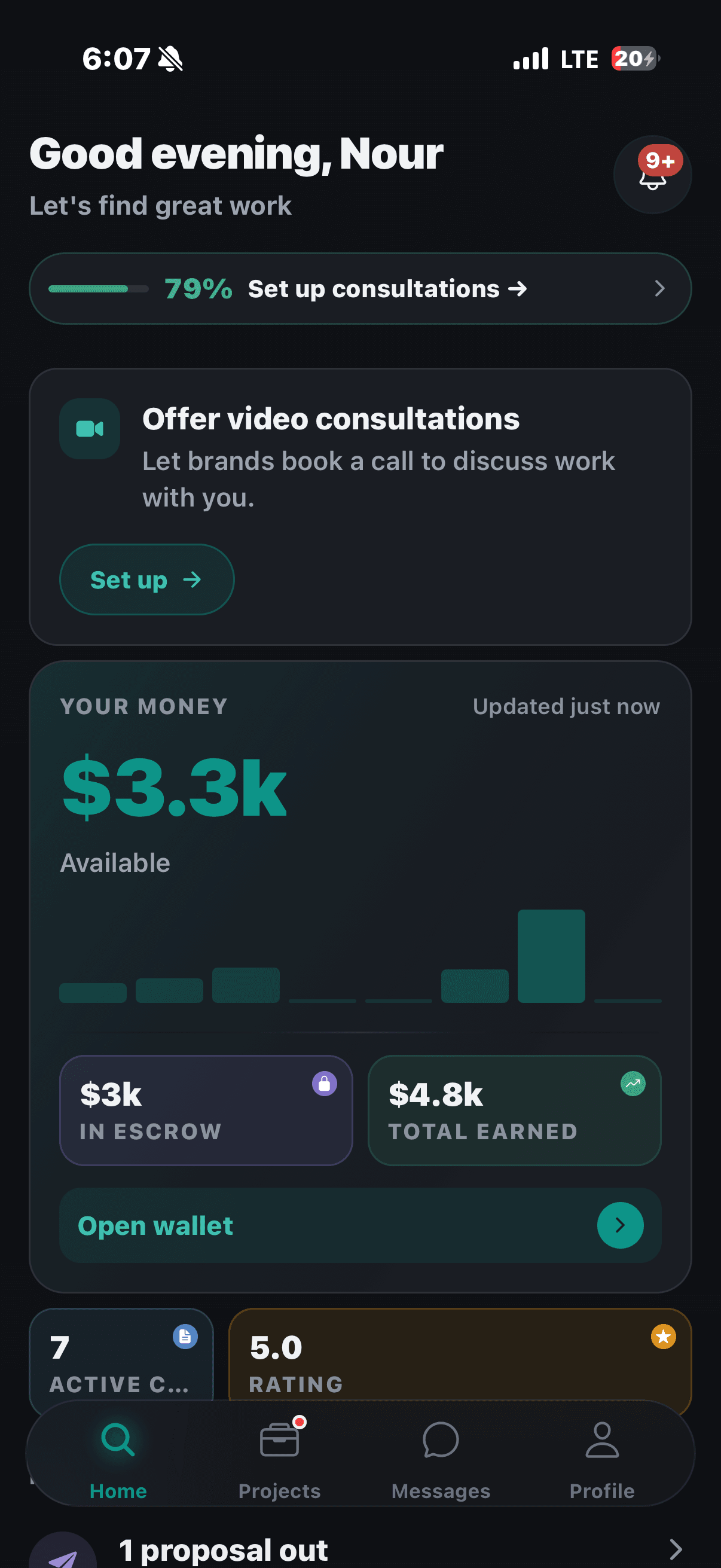
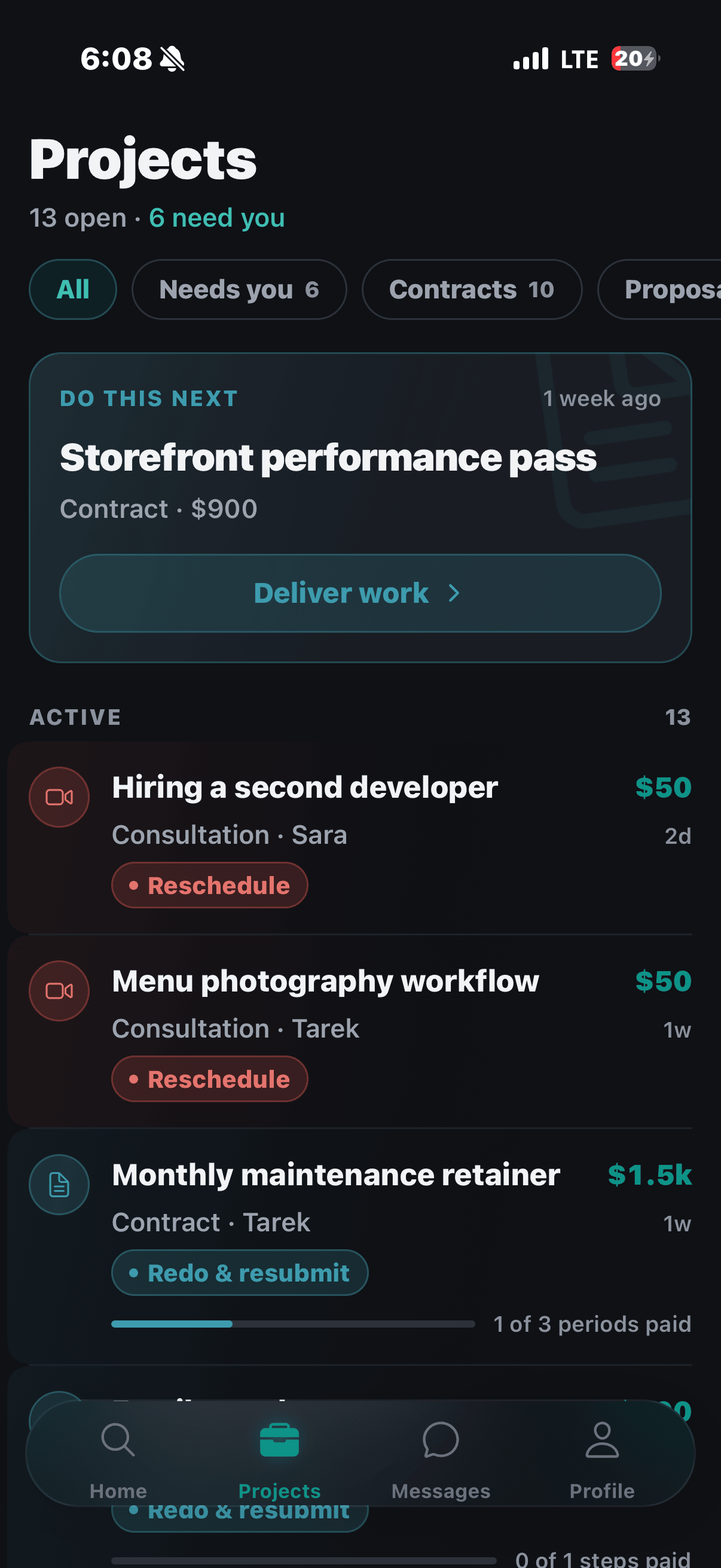
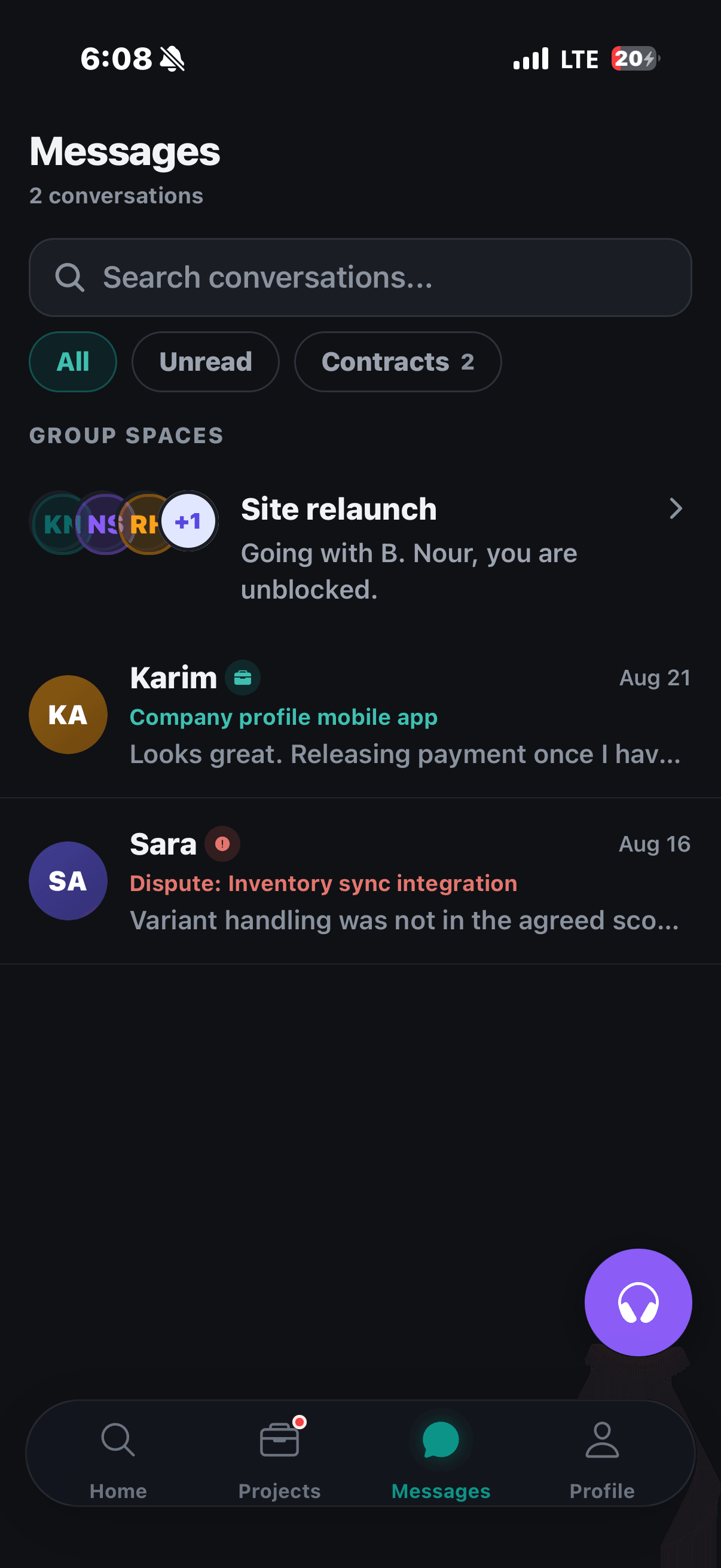
Do the work. Get paid, always.
The client's money is set aside before you start a single hour. You submit, they approve, and it lands in your wallet — never the other way around.
Signing up costs nothing. Nothing is deducted until you actually get paid.
Build a profile that gets picked
Your profile is the thing a client reads before they ever message you. A blank one gets skipped and a specific one gets hired, and the difference is about ten minutes of work you only do once.
You are not filed under one label. Cover the fields you actually work in, and a client searching any of them can find you.
Add the work itself — images, files, the thing you made. A client deciding between two people almost always picks the one they can see proof from.
Furrsati shows no rating and no success rate until you have earned one, never a flattering zero. Nobody is punished for being new.
Set an hourly rate so clients can size you up before they write, then quote whatever the job is actually worth when you send the proposal. Nobody holds you to the first number.
Nothing here is a growth-hack nag. Each line is a thing a client actually reads before they decide.
Blank, not zero. A flattering 0% would read as failure — an empty dash reads as new.
Find work four different ways
Answering postings is only one of them, and it is the one with the most competition. The other three put the client in front of you instead of the other way around.
Every live project, filterable by category, skill and budget. Read the brief, then send a proposal with your own milestones and your own price.
Clients are shown the freelancers who fit their project, ranked on skills, category, track record and rating. An invitation is a client who already wants to talk to you.
Package something you do often at a set price with a stated delivery window. A client buys it outright — no proposal, no negotiation.
A client can send you terms on a job nobody else sees. You can accept it, counter it, or turn it down.
Send a proposal that actually wins
A client reading proposals is not comparing prices. They are trying to work out which of you understood the brief, and the proposal is the only evidence they have.
Break the work into pieces yourself and price each one. A client then sees a plan rather than just a total.
State it, and hold it. A realistic date you hit builds more trust than an aggressive one you miss.
A client can counter, and so can you. The number in a proposal is an opening position for both sides.
Change your mind before it is accepted and pull the proposal. Nothing is committed until a contract exists.
Negotiate without losing the job
Almost every hire on Furrsati moves at least once between the first proposal and the contract. Countering is normal, and the platform is built for it rather than around it.
Counter, and counter again. There is no cap on how many times the number moves before you agree.
Either side can walk away from the whole conversation before a contract is created. Nobody is locked in early.
Every round is kept. What you finally agreed to is never a matter of someone's memory.
Get funded before you start a single hour
This is the part that makes the rest of it safe. The client does not pay you when the work is done — they put the money aside before you begin, and it stops being theirs to take back the moment they do.
The milestone shows as funded in your dashboard. If it does not show funded, you are not obliged to begin.
Held money is not a payment. It is a promise the client can no longer withdraw on their own.
You are never carrying the full value of a long contract on trust, only ever the milestone in front of you.
Deliver work that gets approved the first time
The gap between submitting and getting paid is where projects stall, and almost all of it is avoidable. None of what follows is about working harder.
A draft sent halfway through catches a misunderstanding before it costs you a full revision.
Point back to what the contract actually says, not to what you remember discussing.
A request for changes is not a red flag, and the milestone stays funded the whole time you are making them.
Some things take twenty seconds to say and ten minutes to type. Hold to record, in the same thread as the files.
Get paid the moment they approve
Approval is the trigger. Not an invoice, not a payment run, not thirty days — the client presses approve and the held money becomes yours in the same moment.
The release lands in your Furrsati wallet immediately. There is no clearing period to sit through before you can see it.
Furrsati's service fee is standard 10% and it comes off your side. On a $250 milestone you receive $225, and the exact figure is shown before you ever accept.
They pay the milestone plus a standard 5% card processing fee. Nothing you are charged is charged to them twice.
Funded, released, deducted, withdrawn — your wallet keeps the ledger, so what you have earned is never a thing you have to reconstruct.
Four ways to cash out
Money in a wallet you cannot get out of is not money. Withdrawals are built for the rails people in Lebanon actually use, not for a bank account everyone is assumed to have.
A small balance and a big one do not want the same route out. You choose per withdrawal rather than once, at signup, forever.
What leaves the wallet and what arrives are both shown up front. No fee appears after you have committed.
A person looks at each withdrawal, which is how a mistyped account number gets caught before your money reaches it rather than after.
Cash pickup from any OMT location. Over 1,000 points nationwide.
Instant transfer to your Whish wallet. Send, spend, or withdraw from any Whish agent.
Direct transfer to any bank account. Best for large withdrawals.
Withdraw to your crypto wallet in USDT. No banks, no borders, no delays.
Climb the ladder. Get seen sooner.
Finished work, good reviews and a complete profile move you up the levels. A level changes where you appear — and it is worth being exact about what it does not change.
There is one standard rate at every level. Nobody on Furrsati pays less because they climbed; they simply get found sooner.
Completed milestones, ratings and a finished profile. Logging in more often does not move it.
Level one draws nothing on your card. “Newcomer” beside four other people's badges is an absence dressed as a mark, so it is simply left off.
Your level is part of the score that decides your position in a client's list of matches. The badge and the reason you are being shown are the same fact.
If a client goes quiet
Most projects finish without any of this. But the reason it is safe to work for a stranger on the internet is that there is a way out when it does not, and you should know what it is before you need it.
A silent client does not mean stuck money. The milestone freezes and nobody can withdraw it until it is resolved.
Screenshots, files, the conversation itself. Anything kept on Furrsati is visible to the team reviewing it.
A client who stops replying does not get the benefit of that. The decision is made on what actually happened.
The work matched what was agreed. The milestone is released in full, minus the standard service fee.
The work was not delivered, or did not match the contract. The whole amount goes back.
Some of the work landed and some did not. The held money is divided to match, and both sides are told why.
Your account
The housekeeping: proving who you are, where your money sits, and how to leave if you decide to.
An ID check, done once. It is what lets a client see you as verified, and clients answer verified freelancers first.
Balance, every release, every withdrawal and the fee on each one. Nothing about what you have earned lives only in an email.
Push, email and in-app are separate switches. Turning one off does not turn off the others, and money events are never silent.
You can delete your account yourself, from settings, without emailing anyone to ask permission.